PETROLEUM GEOLOGY
  • Home
  • Content
    • The Reservoir >
      • Reservoir rocks >
        • Sedimentary rocks
        • Rock properties
      • Recovery Techniques
      • Conventional Fluids
      • Nonconventional Fluids
      • Petrophysics
      • Reservoir Estimation
      • Carbonate Reservoir
    • Accumulation and Traps >
      • Basin Environment
      • Structural Trap
      • Stratigraphic Trap
    • Shale oil >
      • History of Shale oil
      • Oil Shale
      • Shale oil extraction
    • Origin of Petroleum >
      • The Subsurface Environment
      • Evaluation of Source Rocks
      • Geologic Time
    • Classification of Crude Oil based on chemical composition
    • More about Petroleum >
      • Types of drilling bits
      • Crude oil emulsion
      • Drilling Fluids/Mud and Components
      • Oil-Rich Countries
      • Petroleum Geochemistry
      • Facts about Petroleum
      • Geologist & Engineer
      • Oil Measurement Unit
      • Forecast of Energy Usage
      • Exploration Techniques
      • Impacts on environment
      • World Reserves
      • Petroleum in Thailand
      • NOC & IOC
      • Digital Oilfields
      • HSE Basic Concepts
    • Geophysics >
      • Career in PE
      • Geophysical surveys for petroleum
    • Blowout Preventer(BOP)
    • Generation & Migration
    • From Exploration to Refining
    • Well logging
    • Real-Time Oil Price
    • Glossary of Oil and Gas Terms
    • Petroleum management systems
    • The last Drop
    • Salt domes
    • Digital Twin in Oil & Gas Industry
    • Abandonment and Decommissioning
    • THE FUTURE OF PETROLEUM
    • UNEXPLORED APPLICATION OF PETROLEUM
  • Introduction
  • Contact
  • About
  • Paraffin Control Mechanisms

World Oil Reserves

Petroleum reserves and Production rate
Petroleum reserves are the amount of technically and economically recoverable oil.
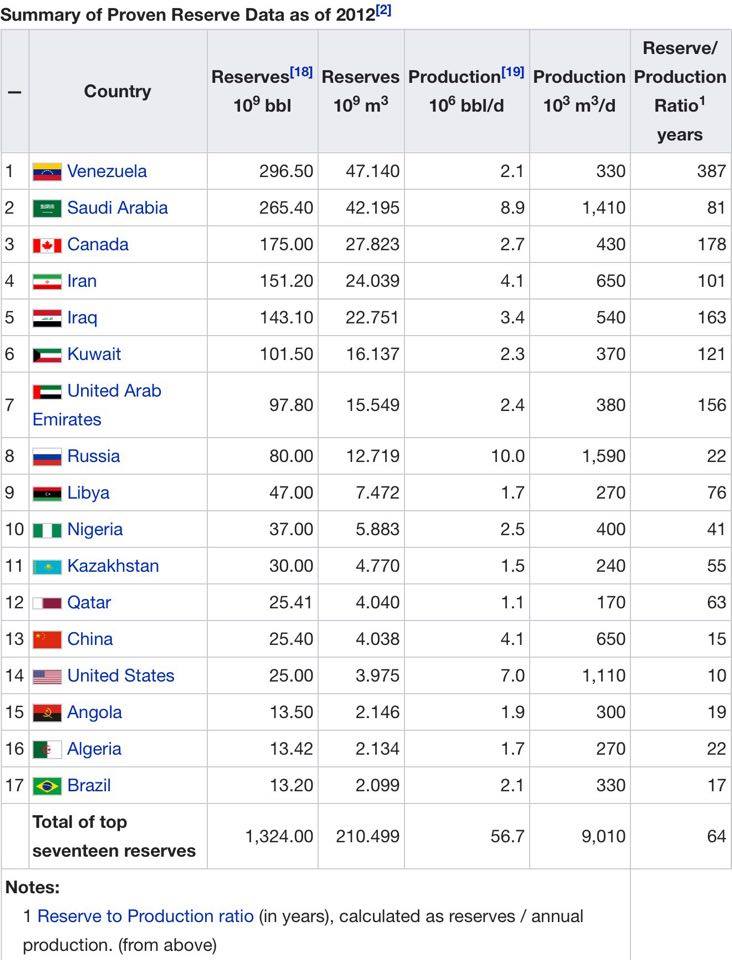
Everyone may think that the highest oil reserves country should be the highest production rate country. But in reality the reserves is not the indicator of the production rate directly at all and it depends on many factors such as petroleum laws, government policy of each country.
Let take a look the relationship between oil reserves and production rate for each country below.
Picture

​For example, Venezuela which has the highest oil reserve in the world. But it is not one of the richest countries in the world the production rate is less than Russia about 5 times despite the fact that It has oil reserves more than Russia up to 3 times.
​The main causes that make Venezuela poor are political corruption and drug problems.
So that why we can not conclude that the most high oil reserves country should be the highest production rate country


​
                                                                                                      
​reference: https://en.m.wikipedia.org/wiki/Oil_reserves

Written by
​
Napat Tangjaichuychat ​

Powered by Create your own unique website with customizable templates.
  • Home
  • Content
    • The Reservoir >
      • Reservoir rocks >
        • Sedimentary rocks
        • Rock properties
      • Recovery Techniques
      • Conventional Fluids
      • Nonconventional Fluids
      • Petrophysics
      • Reservoir Estimation
      • Carbonate Reservoir
    • Accumulation and Traps >
      • Basin Environment
      • Structural Trap
      • Stratigraphic Trap
    • Shale oil >
      • History of Shale oil
      • Oil Shale
      • Shale oil extraction
    • Origin of Petroleum >
      • The Subsurface Environment
      • Evaluation of Source Rocks
      • Geologic Time
    • Classification of Crude Oil based on chemical composition
    • More about Petroleum >
      • Types of drilling bits
      • Crude oil emulsion
      • Drilling Fluids/Mud and Components
      • Oil-Rich Countries
      • Petroleum Geochemistry
      • Facts about Petroleum
      • Geologist & Engineer
      • Oil Measurement Unit
      • Forecast of Energy Usage
      • Exploration Techniques
      • Impacts on environment
      • World Reserves
      • Petroleum in Thailand
      • NOC & IOC
      • Digital Oilfields
      • HSE Basic Concepts
    • Geophysics >
      • Career in PE
      • Geophysical surveys for petroleum
    • Blowout Preventer(BOP)
    • Generation & Migration
    • From Exploration to Refining
    • Well logging
    • Real-Time Oil Price
    • Glossary of Oil and Gas Terms
    • Petroleum management systems
    • The last Drop
    • Salt domes
    • Digital Twin in Oil & Gas Industry
    • Abandonment and Decommissioning
    • THE FUTURE OF PETROLEUM
    • UNEXPLORED APPLICATION OF PETROLEUM
  • Introduction
  • Contact
  • About
  • Paraffin Control Mechanisms